Coding & Robotics
Children learn to code by programming real robots.
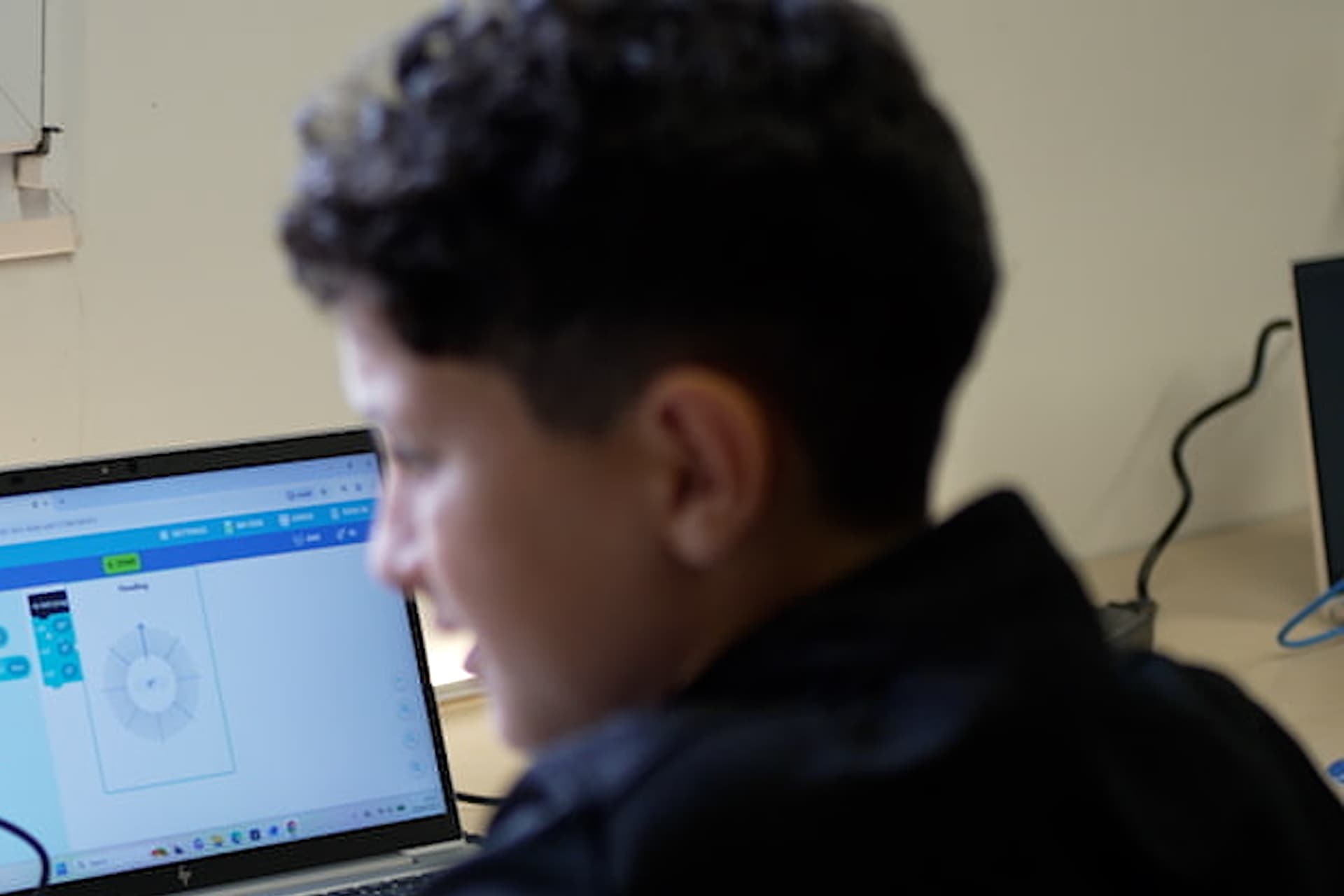
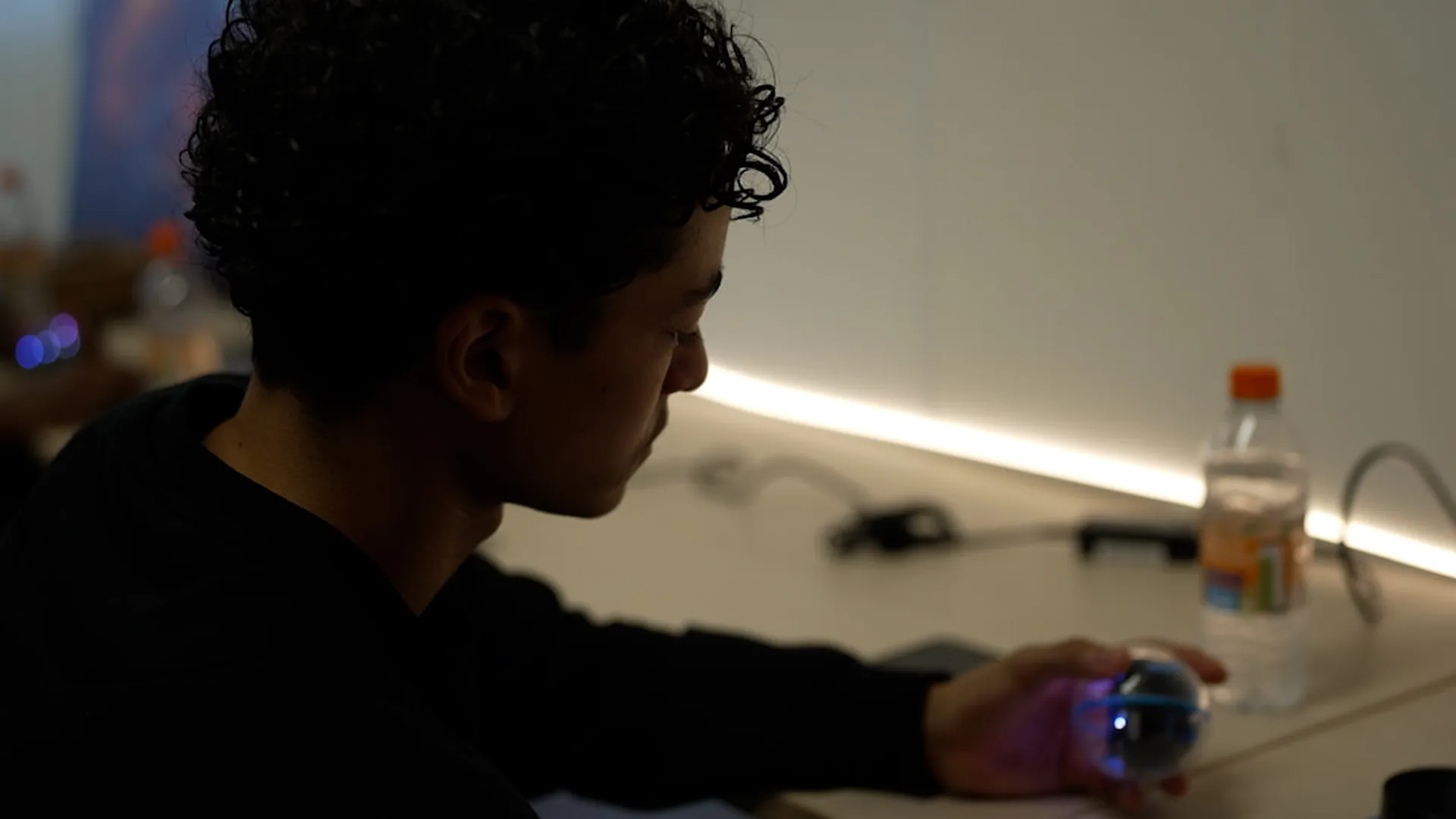
One course, taught properly. Your child will learn to program real robots in small groups, each child working at their own level and pace, and will have the same mentor each week. Beginners start with block-based coding whatever their age - 7 or 17 - and move up to writing real Python once they have earned it. This is not screen time with a robot attached: it is the formation of engineers and creators. The pathway is built to take a child to the point where they can break a problem down, write and debug real code, read and wire sensors, build an autonomous machine end to end, and meet the introductory AI behind how it senses and decides.
- One two-hour session a week - Saturday or Sunday
- In person in Leicester - Mowmacre Sports Ground
- A wristband at every band, a certificate at every stripe
- Progress at your child's own pace, never by age
Eight bands. Every one earned, never given.
Your child will earn a coloured wristband at each band - and keep it. A band will only be awarded when a mentor has watched them demonstrate the capability unaided: never by age, never by attendance. This is exactly what your child can independently do at each level.
- BronzeDriver
Programs movement as a step-by-step sequence - direction, distance, colour and sound - and plans it out before writing a line of code.
- SilverCoder
Uses loops and events so the robot repeats and reacts - and can read a program and predict what it will do before running it.
- GoldLogician
Uses if/else decisions and variables for logic and memory, keeps score, and debugs their own program when it misbehaves.
- PlatinumBuilder
Writes their first typed code - translating working block programs into Python, organised with functions - and transfers those skills to a second robot.
- RubyProgrammer
Writes original Python from a written brief using live sensor data, to a real code standard: every line commented, every name clear.
- EmeraldEngineer
Combines sensors into working systems, logs real data, and builds real electronics in C++ - the second language on the pathway - proving their skills transfer across different hardware.
- SapphireRoboticist
Delivers real-world autonomy - line-following, obstacle response - designing the solution rather than following one, and carrying what they know onto a board they have not used before, working from the official documentation.
- DiamondInnovator
Builds an original robotics project end to end, documents it, demonstrates it - and begins mentoring younger builders.
Beyond Diamond: competition robotics, advanced projects, a deeper introduction to AI, GCSE Computer Science preparation, and a route toward becoming an assistant instructor. Standalone game development is on our roadmap as a future course.
Every child starts at the right level
It begins with a short, practical set of graduated challenges. The highest one your child completes independently sets their starting band. Nobody sits through what they already know, and nobody is thrown in too deep. Before your child starts, we'll walk you through the programme, the timetable and the pricing in full, with no obligation to enrol - how we build the right pathway for your child from day one, not a one-size-fits-all class.
Stripes, certificates and steady proof
Each band divides into four quarters. The first three each earn a stripe and a certificate; the fourth earns promotion and the next wristband. Assessment is continuous and practical - a stripe will be awarded the moment a mentor has seen your child do it unaided.
Two hours, the same shape every week.
A predictable structure children can settle into - with every task available in a supported version, and the room kept calm and low-sensory. Children build together in defined roles that swap during the session, and work on their own where a task calls for it. The pace-per-child model is built in, not bolted on.
- Welcome & brief15 minEach child's goal for today, set at their own band.
- Build - part one40 minGuided work at their level. On typed-code bands, they read and predict real code first.
- Break10 minRest and reset.
- Build - part two40 minExtend and personalise - push the project further.
- Show & reflect15 minEvery child demonstrates what they built, and explains it in their own words.
Classes are capped at eight, every class will have a mentor and an assistant in the room, and your child will have the same mentor each week. Children learn a great deal from working together - but a band is only ever awarded on what your child can do on their own.
The weekly timetable
- Book a free trial lesson - Younger Programme, Saturday & Sunday 10:00am-12:00pm
Saturday & Sunday
10:00am-12:00pm
Younger Programme · Ages 7-10
- Book a free trial lesson - Older Programme, Saturday & Sunday 12:00-2:00pm
Saturday & Sunday
12:00-2:00pm
Older Programme · Ages 11-15
- Join the waiting list for Younger Programme, Monday-Friday 4:30-6:30pm
Monday-Friday
4:30-6:30pm
Younger Programme · Ages 7-10
- Join the waiting list for Older Programme, Monday-Thursday 6:30-8:30pm
Monday-Thursday
6:30-8:30pm
Older Programme · Ages 11-15
- Join the waiting list for Juniors Programme, Friday 6:30-8:30pm
Friday
6:30-8:30pm
Juniors Programme · Ages 16-18
Children attend one session a week. Saturday and Sunday classes are open to book now; weekday evenings are waiting-list only, and we'll email you the moment one opens.
Classes run in person at Mowmacre Sports Ground, Thurcaston Road, Leicester LE4 2RG. There is free parking on site - come in through the main Sports Ground entrance.
The same capability, growing as they do.
Seven skills run through every band. They start concrete and become genuinely professional.
Computational thinking
- Ages 7-10
- Breaks a task into clear, ordered steps
- Ages 11+
- Decomposes a system into parts and designs how they interact
Logical reasoning
- Ages 7-10
- Predicts what will happen before running it
- Ages 11+
- Reasons about conditions, state and edge cases
Debugging & resilience
- Ages 7-10
- Finds and fixes their own mistakes without giving up
- Ages 11+
- Diagnoses faults methodically, from evidence
Precision
- Ages 7-10
- Learns that a machine does exactly what it is told
- Ages 11+
- Writes clean, commented code another person can read
Engineering mindset
- Ages 7-10
- Tries, adjusts, tries again - iteration as a habit
- Ages 11+
- Defines a problem, designs, prototypes, tests, improves
Data literacy
- Ages 7-10
- Reads what a sensor is telling the robot
- Ages 11+
- Gathers and logs real sensor data, and reasons from it
Communication & independence
- Ages 7-10
- Explains what they built and why
- Ages 11+
- Owns a project end to end and documents design decisions
The Younger Programme (7-10) is aligned to Key Stage 2 computing. The Older Programme (11-15) is aligned to Key Stage 3 and forms a pathway toward GCSE Computer Science. The Juniors Programme (16-18) takes the same pathway furthest - it is not running yet, and families can join the waiting list.
Understanding AI, not just using it.
A separate strand that runs alongside the robotics from the Silver band upwards - taught on the robot in front of them, in the session they are already in.
Rules, not magic
Silver band
Explain the difference between a machine following rules a person wrote and a machine that has learned from examples.
How a machine decides
Gold band
Trace a decision their robot made back to the sensor reading and the rule that caused it.
Patterns and categories
Platinum band
Choose which sensor reading tells two situations apart, and say why that one and not another.
Data shapes behaviour
Ruby band
Show how changing the conditions, not the code, changes what the machine does - and say why that matters when a machine decides something about a person.
Learning from examples
Emerald band
Describe the difference between a rule they wrote and a pattern learned from examples, using data they collected themselves.
Autonomy and its limits
Sapphire band
Name a situation their own autonomous robot would get wrong, and say what a person should decide instead.
Building responsibly
Diamond band
Use an AI tool to help with a build, say plainly what it contributed, and explain the finished result without it.
Your child is not training artificial-intelligence models, and we won't tell you they are. Every outcome here is something a mentor can watch them do, unaided, with the kit already in the room - the same standard that awards a band.
Start with a free trial lesson
Every session is taught in person in Leicester, and built for personalised learning. Book your child's free trial lesson and you'll leave with their starting band on the pathway in writing - free, with no obligation.
Classes are capped at eight, and run weekly and at weekends in Leicester.